
Bitcoin Forgives Nothing: Structures That Create or Destroy Value


Not every treasury strategy plays out as planned
Bitcoin doesn’t forgive. You can stack sats with the best of intentions, raise capital, publish sharp slogans, and design a corporate structure that looks flawless on paper. The market, the shareholders, and reality still get the final word. Some corporate wrappers create value. Others destroy it. The difference rarely lies in the asset. It lies in the structure built around it. This week made that clear. One company liquidated and returned capital. Another changed its CEO and its thesis. A third launched with a different model from day one. And nine of the sector’s largest institutions committed to funding Bitcoin development while signing a pledge not to steer it.
Satsuma: the case that stings and teaches
Satsuma Technology raised more than £160 million to become a public Bitcoin treasury vehicle on the London Stock Exchange. Less than a year later, shareholders voted, with over 90% in favor, to sell its 668 BTC, delist from London, and return whatever capital remained.
Bitcoin didn’t disappear. The company did. Shareholders chose to liquidate rather than stay trapped in a vehicle trading at a deep discount to its own assets.

That was not a failure of BTC. It was the failure of a structure that could not hold investor confidence or justify its own existence once the treasury premium turned into a treasury discount.
The lesson: accumulating BTC is the first step, not the model. Protecting value per share, controlling dilution, maintaining liquidity, and defining clear exit rules from the outset is what separates a durable strategy from one that unwinds within twelve months.
Jack Mallers leaves Twenty One Capital
Jack Mallers, founder of Strike, has resigned as CEO of Twenty One Capital (XXI), the second largest public BTC holder after Strategy. Seven months after a launch that carried enormous expectations — Tether backing, an NYSE listing, roughly 43,514 BTC — the company is reconsidering its model and Mallers is returning to Strike full time.
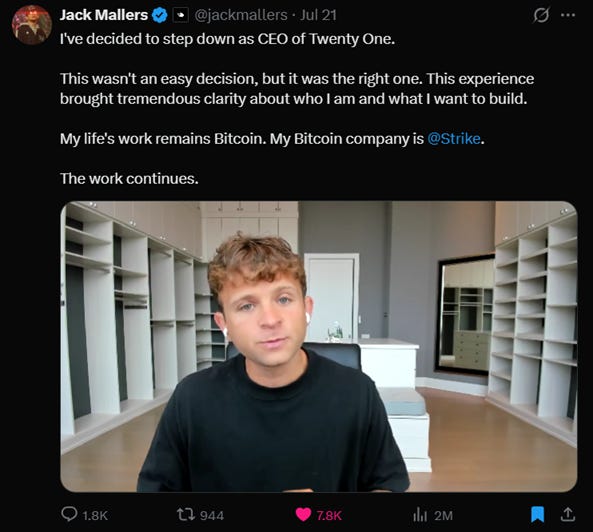
Mallers has always embodied a more cypherpunk vision: instant payments over Lightning, real adoption in El Salvador, a product-first approach. It stands apart from Michael Saylor’s highly corporate, leveraged model.
That contrast surfaced publicly in June at Bitcoin Corporate Day in Prague, when Mallers questioned the use of mNAV as the primary metric for treasury companies: reducing everything to BTC per share ignores whether the underlying business is operationally sustainable.
Twenty One launched with an ambitious narrative — a large BTC position plus a planned merger with Strike and Elektron to build an integrated, Berkshire Hathaway–style platform. That consolidation is now off the table, or at minimum heavily reworked. The new leadership under Raphael Zagury is leaning toward cash flow generation, lending, and financial services.
Holding Bitcoin and running a sustainable public company are not the same assignment. A large BTC position can support a business model. It cannot replace one. XXI learned quickly that the pure treasury model comes under pressure when the equity premium compresses and investors can get the same exposure through an ETF without absorbing governance, dilution, and execution risk. Mallers is leaving voluntarily, with a clear path ahead: his life is still Bitcoin, but through Strike.
ORANGE JUICE: the permanent hybrid model
As a constructive counterpoint, Lyn Alden, Jeff Booth, and the Ego Death Capital team launched ORANGE JUICE, raising $40 million to acquire cash-flowing American businesses (roughly $1–10 million in annual free cash flow), improve them operationally including through AI, and hold them indefinitely, backed by a Bitcoin treasury. Ricardo Salinas is an anchor investor. This is neither a pure-play holder nor traditional private equity, which typically levers up and exits within a few years. It is permanent ownership with real cash flows, and Bitcoin as the store of value behind it.
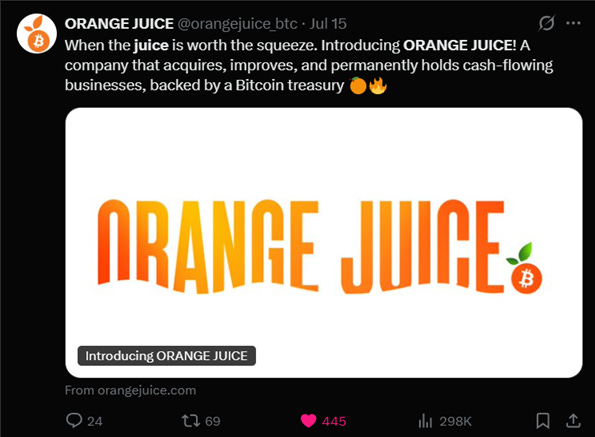
Why it matters: it is the mirror image of Satsuma. Where one model depended on a premium to NAV to justify itself, this one generates cash from day one and treats Bitcoin as the destination for surplus rather than the reason for existing.
BIP-110: two different ways of saying no
Michael Saylor published a lengthy essay, “110 Reasons Why BIP-110 Is a Bad Idea,” opposing the temporary soft fork that would limit non-financial data on chain, such as Ordinals. His argument is about precedent: Bitcoin needs guardians of neutrality, not of monetary purity. Changing consensus rules to restrict fee-paying use cases cuts against the protocol’s permissionless spirit. Better to manage spam through market fees, relay policy, and higher layers.
Dylan LeClair, Director of Bitcoin Strategy at Metaplanet, reached the same rejection by a different and considerably blunter route. He noted that he has run a Bitcoin archival node for six years, and said he will not support a contentious consensus change — least of all one that fails on its own terms. BIP-110 does not stop data insertion. He called it a “virtue signaling exercise that accomplishes nothing“ beyond forking off its own supporters. The technical objection is not a fringe view.
The project’s own documentation acknowledges the argument that arbitrary payloads can still be encoded as valid Tapscript, which would leave limits on recognized data carriers largely ineffective. The numbers agree. Miner signaling remains below 1%, far from the 55% threshold required for activation, with the mandatory signaling window opening in early August around block 961,632. Adam Back has also come out against it. BIP-110 looks set to produce, at most, a minority chain.
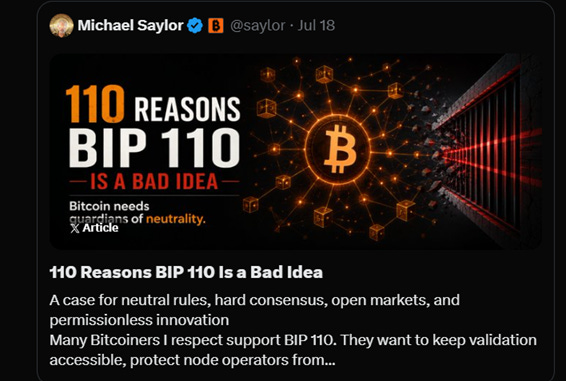
Two objections, two angles: Saylor fears the precedent, LeClair points out that it doesn’t even work.
Bitcoin Security Consortium: fifteen million and a promise not to govern
On July 23, nine institutions — Anchorage Digital, ARK Invest, BlackRock, Block, Blockstream, Coinbase, Fidelity Digital Assets, Galaxy, and Strategy — launched the Bitcoin Security Consortium, pledging $15 million over three years to fund the developers and researchers already working on the network’s security.
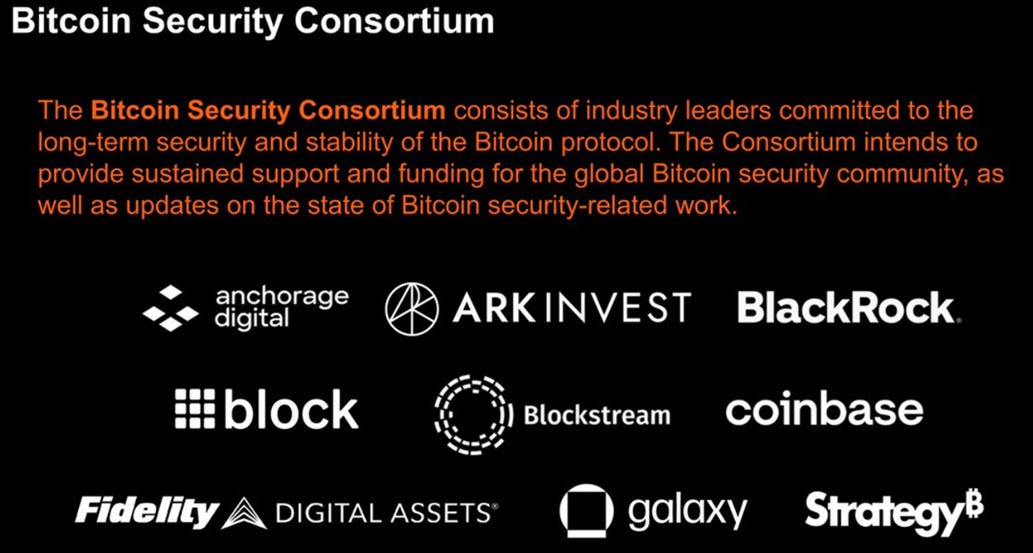
The first focus is quantum computing. Coordination falls to Mike Schmidt, Executive Director of Brink, serving as a volunteer with no compensation from the consortium. His public explanation deserves attention, because it met the skepticism head-on rather than sidestepping it.
Schmidt acknowledged that he knew exactly how it sounds when nine giant institutions form a group to “help” Bitcoin, and said he had the same reaction himself. Before accepting, he spoke one-on-one with each company to assess their values and priorities. Two conditions were non-negotiable for him, and he found the members already aligned on both:
-No pooled funding. Each company funds whoever it chooses, independently. The consortium holds no money and picks no recipients.
- No consortium positions on protocol changes. In his words: “members speak for themselves“.
Schmidt continues to run Brink independently, has committed to a year in the role — possibly two — and views the seat as one that should rotate over time. On the quantum threat, his framing is deliberately sober: a sufficiently powerful quantum computer would break Bitcoin’s current signatures, but what is usually wrong are the loudest imminent-doom voices. The development community is already working on it. His stated aim is to act as a measured counterweight in both directions — no doomerism, no dismissal.
And here is the connection to BIP-110.
That second red line — no positions on protocol changes — is not a bureaucratic detail. It arrives weeks after the BIP-110 fight put the uncomfortable question on the table: who decides Bitcoin’s rules when the largest holders of the asset are listed companies and asset managers? Saylor argued against BIP-110 on grounds of neutrality.
Weeks later, Strategy is co-funding development of that same protocol and signing a pledge not to steer it. It is coherent, but the tension is real and a press release does not dissolve it. Particularly because the chosen focus — quantum — will eventually require precisely what BIP-110 could not achieve: a consensus change with broad support. Funding the technical work while staying out of the decision is easy to write down. It will be harder to hold when something actually needs to activate.
For treasury investors: this is long-horizon incentive alignment. Anyone holding BTC on their balance sheet wants a secure network for decades. It is also the first time Wall Street has directly funded the people who maintain the code, and that relationship deserves watching.
Clarity Act: less clarity than expected
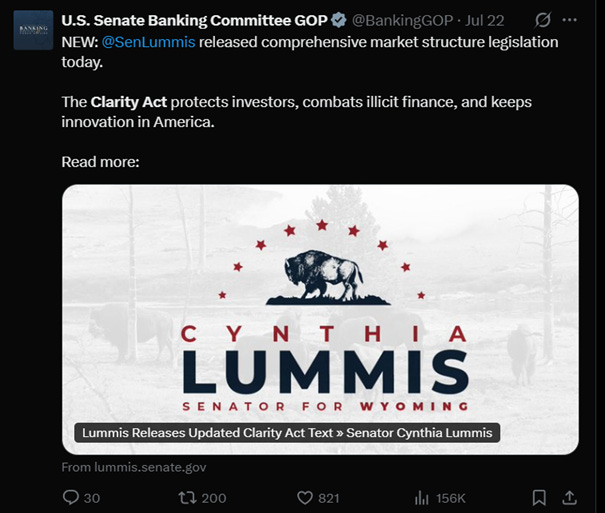
The Clarity Act is still live, but the optimism has cooled. For weeks negotiators described it as nearly done, and a vote before the August recess looked probable. This week the odds slipped, and the market noticed. The bill would establish the SEC/CFTC jurisdictional split, along with protections for developers and for self-custody. If it doesn’t pass in August, the next realistic window is 2027, with weaker bipartisan momentum.
The market: macro sets the direction
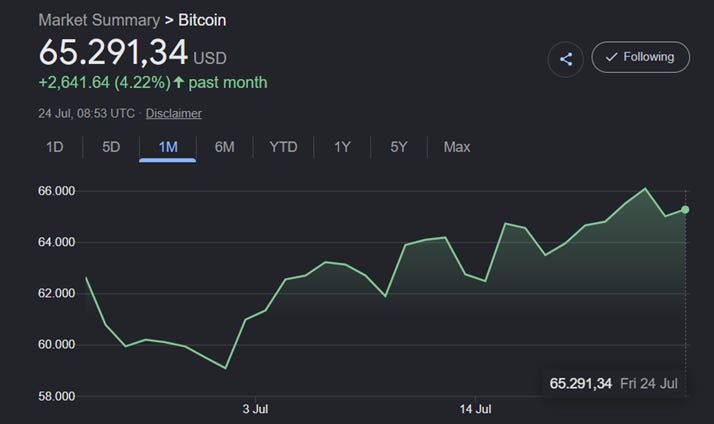
BTC is trading around $65,500. The July 23 decline came from outside the sector: rising oil prices, climbing Treasury yields, and a falling Nasdaq. On the constructive side, spot ETFs strung together several consecutive days of inflows before the turn, and long-term holder accumulation remains steady. This week macro set the direction, not the Bitcoin narrative.
Adaptation is the only constant
Satsuma liquidated. Twenty One is pivoting after Mallers’ exit. ORANGE JUICE is building a permanent holding company. Saylor is defending protocol neutrality while his company co-funds the people who write it. Each team adapts Bitcoin to its own vision: some more corporate, some more cypherpunk. None of them has a guaranteed outcome. Bitcoin is still the asset. Everything else is engineering and honesty. The strategies that last are the ones that listen to the market, generate real value, and stay true to their original principles. Stack sats, choose or build your wrapper carefully, and keep going.
***Important Disclaimer: This is a personal and educational analysis based on publicly available information. It does not constitute financial, investment, tax, or legal advice. Always verify the status of any platform or project from official sources before making any decisions. Cryptoassets are highly volatile and you may lose part or all of your capital.